To be kept up to date with our forthcoming courses, click here.


Chief Instructor

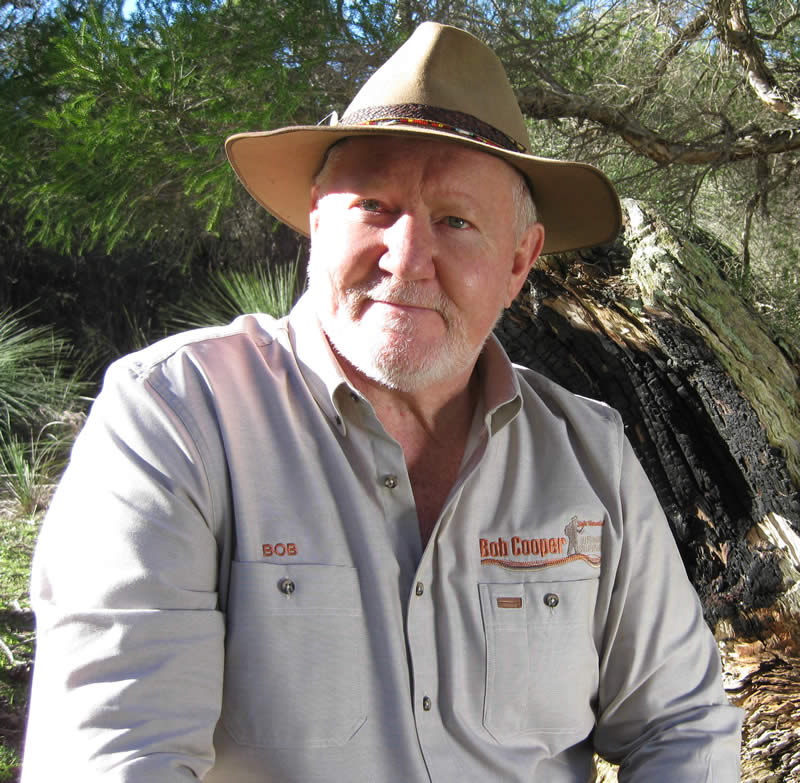
Bob Cooper

Born and educated in Perth, Bob Cooper’s passion for nature was fostered by childhood walks exploring bushland around his home near the Swan River, followed by teenage years spent bushwalking near Canning Dam. A hike from North Beach to Yanchep with limited food and water was his first survival trial.

Early occupations included commercial fisherman and professional diver – and it was the latter job which taught him first-hand the advantage of controlling one’s thoughts and not panicking.

For over 25 years Bob has honed his survival skills by learning from traditional cultures in Australia, Africa and North America. His experiences include living for extended periods with Aboriginal people in our Western Desert, sharing bushcraft abilities with the Bushmen of the Kalahari in Botswana and spending time with the Lakota Sioux Indians in Dakota.

His roles have included instructing the Special Forces Units in Western Australia, lecturing with the Texas Parks and Wildlife Service on survival in the Mexican Desert and delivering wilderness lessons in the UK.

Bob has also organised many projects throughout Australia, from social adventures with movie stars and other international celebrities to personal development courses for Youth at Risk.

In 2000 National Geographic America filmed Bob conducting his advanced survival courses in the television series True Survivors which featured on the Oprah Winfrey Show. More recently he has participated in two documentaries with the BBC in the UK and a segment on 60 Minutes in Australia.

Bob’s long term commitment to protecting and enhancing the enjoyment of people venturing or working in the Australian bush, won his Outback Safety and Survival Course the prestigious Excellence in Safety Training Award, from the State chapter of the Safety Institute of Australia in 1996.

Over the years Bob has witnessed the fear of death during land, sea and air mishaps where a potentially fatal outcome, for himself or others, was real. Survival skills can replace fear with respect for, and trust in, nature. Such knowledge enables people to walk freely and be nurtured by the “soul food” of the natural environment.

Many irrational fears cloud people’s engagement with the outback – and even with natural habitats in suburbia. Fear of snakes, spiders, being lost or alone are acquired fears. Knowledge is the key to dispelling them.

As a society we need to recapture the survival skills and empathy with nature which our ancestors instinctively knew. True appreciation of our natural environment may be the only factor that saves it and, on occasions, us.

Teaching is Bob’s contribution to this necessary new awareness.


 Mike House

For as long as he can remember, Mike House has found the diversity and detail of the natural environment a source of wonder.Having grown up on a farm on Western Australia’s southern coast, his ongoing love for the outdoors is reflected in pastimes such as sea kayaking, rock climbing, caving and bushwalking.

Mike’s previous work has included introducing corporate bodies to the mastery of abseiling, white water rafting and other physical challenges. However, his career focus has been contributing to disadvantaged groups in the community such as the deaf and blind, disabled school leavers seeking life skills, the long-term unemployed and young people living on the streets.

As a survival and roping instructor with Bob Cooper Outdoor Education, Mike continues to generate personal growth in sectors ranging from at-risk youth to local and international management teams. At a spiritual and emotional level he believes the Outback Survival Courses help participants reconnect with the land and realise that many supposed necessities we depend upon are, actually, not critical to our lives.

Mike emphasises this understanding does not influence what he chooses to own, but it does alter his attitude to the technology which gives many of us a false sense of security and insulates us from life’s realities. For example, global positioning systems are mostly very reliable but if such a tool failed for whatever reason, most people would have no idea where they were in the outback. When taught how to make do with a few natural resources in an emergency, they can venture forth with greater personal confidence.

At a practical level Mike regards learning such knowledge as important. But even for people who do not intend going bush in the near future, the mental skills they learn on the courses can be utilised daily. Conscious planning, awareness of emotion and interaction with others can be applied to any setting - even corporate life in the city.


  Bob Hunter 

An avid childhood collector of anything and everything that was nature-based – rocks, shells, cacti, pressed plants and the passion keeps growing along with the collections.

Bob is a keen horticulturalist who has an insatiable hunger for knowledge about our world and everything that lives in and on this planet.

Exploring was encouraged by parents who packed the car and the family up regularly for trips to unexplored areas and if the track didn’t get them home then the camp gear appeared and the adventure continued. Camp cooking is one of Bob’s many skills and he has satisfied many a hungry course participant. (Breakfast ‘hooch’ and ‘Frogs in a Pond’ being his trademark dishes!)

Meeting and participating in Bob Cooper programs helped him to gain more knowledge about survival skills which brought an understanding of just how close he had come to grief on occasion and prompted a desire to teach others how to avoid these sorts of situations. Being exposed to survival education (which, is in a lot of cases, just a reminder of what we really do know or have already been exposed to), can save lives in such situations by replacing fear with awareness.

Bob believes that we are not totally removed from nature, even in today’s society where we are led to believe that we can control the world. It is only when nature ‘bites back’ that we are very quickly reminded that this is not the case. Having survival skills and an appreciation of nature can, not only assist us to make good decisions in those situations, but it is good for our soul as well.

He gets great satisfaction from the teaching role he performs as part of Bob’s team.


Vanessa Paget

Born in Western Australia, Vanessa’s childhood was strongly influenced by the beauty and harshness of the Kimberley Region and by her parents who’s practical, hands-on approach to their surrounds fostered a love and understanding of nature and fuelled her passion for wildlife.

Her adventurous father hunted crocodiles with aboriginal friends providing wonderful opportunities for shared wisdoms including how to read the language of the bush, ways to care for our natural environment and helped develop Vanessa’s understanding of bushcraft and survival.
 
For more than 20 years her career as an adventure leader has taken her from active roles with the Texas Parks and Wildlife Service to BBC television documentaries about survival.

Her association with Bob Cooper Outdoor Education began when she attended a Basic Survival and Outback Safety Course which became a life changing experience and one which helped Vanessa to see clearly the purpose for her childhood learnings, her passion for wildlife protection and varied outdoor hobbies. Now these skills are used to inspire others to be at ease in their natural environment.

Working with schools and various educational programs Vanessa presents wildlife workshops, customised Bush Survival and Snake Awareness programs.

Participants walk away with a new understanding of their surrounds, appreciating the beauty of nature and through a process of knowledge, gain skills in developing their confidence and self-reliance.


Kelly Caple

Kelly shares a keen interest in the environment and her community, with a passion for education, both for herself and others. At the age of 13 she participated in a number of projects over a 5 year period as a Conversation & Land Management (now DEC) cadet and graduated as one of the founding year. She continued as a cadet leader for 2 years and still has input into various units.

Formal studies include a Diploma in Environmental Management and university studies are ongoing in this, her chosen field. Many environmental interests have been pursued and other credentials include reptile handling and reptile removal, sustainability, outback safety and survival, 4 wheel driving, a senior first aid certificate and bronze medallion which make for a multi skilled educator.

Kelly also finds time to play an active part in the Volunteer Bush Fire Brigade and has been a committed community member since 2004. Her other roles include being a keen Conservation Volunteer and the training officer for the Serpentine Jarrahdale incident support group (ISG). Her commitment to the community resulted in being awarded with the Rotary Youth Leadership award in 2003.

Kelly’s career and life objective is to “educate and increase community awareness on environmental issues to create a better tomorrow.” 


 Ian Dunnet

As the son of an eminent zoologist Ian Dunnet grew up on a Scottish research station where ecology was a prominent part of his formative years.

He went into a different science - medical microbiology - which turned out to be a career that allowed him to travel the world and have a range of life experiences which few people are lucky enough to achieve.

Over the course of 30 years Ian has lived in the UK, Cyprus, Saudi Arabia, the Sultanate of Oman and New Zealand, before returning to his birth city of Perth in Western Australia.

Having often observed and sometimes been able to help wildlife at risk, he sees his work with Bob Cooper Outdoor Education as a way to raise public awareness about our diminishing world. Ian also believes that so-called primitive societies have much to teach us. 

His first encounter with venomous species came in Oman in 1990, when a horned viper was discovered in the midst of a desert camp. He recalls the panic which overtook everyone. Most people wanted the snake destroyed because there were children at the camp but Ian sensed the pointlessness of this exercise. Instead he simply scooped up the viper on the blade of a shovel, walked it a good safe distance and watched it bury itself in the sand.

His next interaction with venomous species was in Bob Cooper’s company. Ian understands that knowledge is the key to defeating an unnecessary fear of reptiles, and he enjoys being a vehicle for delivering that knowledge.

Through Bob’s Outback Survival Courses Ian has seen participants’ reactions change from horror to acceptance and, eventually, to admiration for these fascinating creatures. Watching people gain in confidence is his first reward; the second is realising they have gained the understanding that destruction of a venomous animal should be the very last resort.